Takahashi Mewlon 210 Vignetting on Full Frame

The Takahashi Mewlon 210 Dall-Kirkham Cassegrain only has an 18mm image circle at prime focus, and 39mm with the dedicated reducer.

Here are some images of daytime scenes taken with a Canon 6D full-frame DSLR.

Native focal length (2415mm, f/11.5)


With a Televue TRF2008 0.8X reducer/flattener for the TV85 (designed for 600mm radius of curvature) (f/9.2)

and with an Altair Astro 0.6X reducer/flattener (no longer available, but also sold by some other Europe-based sellers) (f/6.9)
 I will try to get some images of a large globular like Omega Centauri when I get the chance, but the illuminated field is not bad at all (an f/4 newtonian with a Paracorr has a comparable field to the Mewlon with the 0.6X reducer!)


Takahashi Mewlon 210 Maintenance

I've been looking for a Takahashi Mewlon 210 Dall-Kirkham Cassegrain since about 2010, but the new prices are pretty high and I didn't want to pay list price. I was able to find a used one (I am probably the third or fourth owner) on SingAstro for a pretty fair price. The downside was that it had some dings on the paint.

I had some enamel repair paint and some Canon touch-up paint for old grey L lenses (not a perfect color match for Takahashi hardware) but they suffice for now.

After a thorough cleaning (lots of black marks on the Takahashi hardware came off with the use of a rubber pencil eraser) I found several areas where there was paint loss. On the gloss-white tube, I used the enamel repair paint.

Before and after:

A large area of paint loss on the front of the tube:


A smaller area where the paint flaked off, also on the front of the tube:


 A ding on the finder bracket, and after patching with the Canon paint:


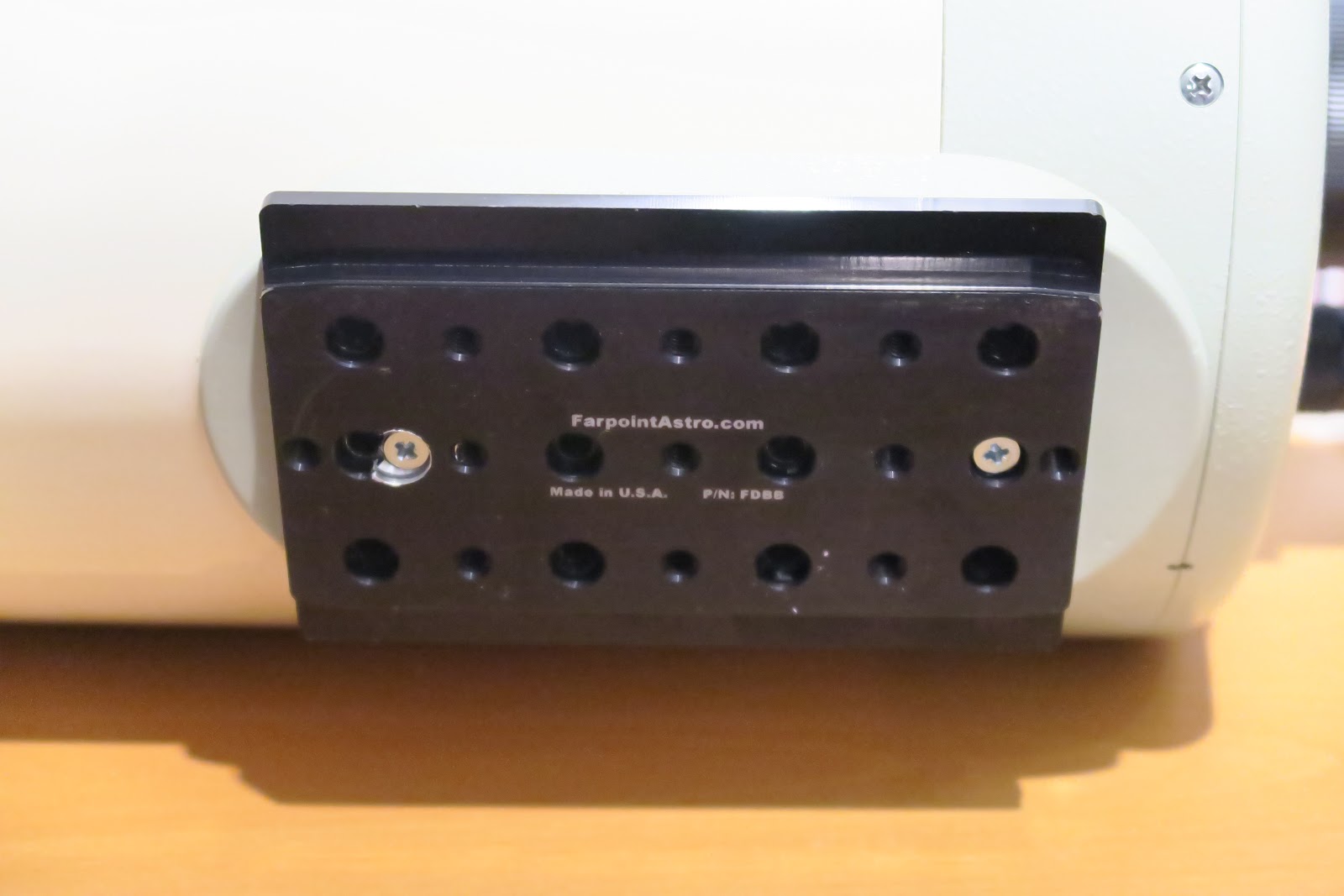
The Mewlon also came with a Vixen dovetail, but I wanted to mount it on my Mach1 mount and did not want to buy tube rings (which cost more, and add unwanted weight). I had a short Losmandy dovetail from FarPoint Astro, but it didn't have the holes in the right spots.

So I bolted the stock Vixen dovetail to the FarPoint dovetail and centered it so that I could use the Vixen dovetail as a drilling guide.


And after drilling. The second hole was not very well done; but it's not visible when clamped on the Losmandy saddle; and is definitely not visible at night!


Also, I found that the cheap reticle illuminator from a Seben reticle eyepiece actually fits in the reticle socket of the 50mm finder (not very well, however):


I did feel some grittiness when screwing in the illuminator plug afterwards; I think some metal came off the cheap Seben illuminator due to the not-quite-correct threading. So I probably have to buy the real Takahashi illuminator.

After maintenance, attaching the Losmandy dovetail, and mounting on the Mach1:


Canon 28-105mm f/3.5-4.5 USM II

TL; DR - use it at f/8 and it has (almost) L-class sharpness.

Back in 2001 or 2002 this was one of the lenses I wanted. It was too steep for me and I ended up with a Sigma 28-105mm f/2.8-4 (the infamously soft and bulky lens) which I used for some time on an EOS3000N and EOS50 until it got damaged (diaphragm stuck wide-open).

Fast-forward fifteen years and I have one from KEH for about $120 in "bargain" condition.

I have two lenses that cover (parts of) the range of this 28-105mm: the 16-35mm f/4 L IS, and the 70-200mm f/2.8 L IS. I was planning to compare these lenses but it turns out that The Digital Picture already has a lens comparison service. So here's the summary (so far as I can tell) on a 5D Mk III (which has the same sensor as my 6D):

Compared to the 16-35mm f/4 L IS (an $800 lens):
  • at 28mm and f/8, the 28-105 almost matches the 16-35mm wide-open (at f/4)
  • this is also true at 35mm
Compared to the 70-200mm f/2.8 L (a $1200 lens):
  • at 70mm and f/8, the 28-105 matches the 70-200mm at 70mm wide-open (at f/2.8) and at f/4, but notably the 28-105 has better corners than the 70-200 (note we are comparing f/8 to f/2.8 and f/4)
  • at 105mm and f/8, the 28-105 matches the 70-200mm at 100mm wide-open (at f/2.8) and at f/4, but the 70-200 beats the zoom in the corners even at f/2.8
The long and the short of it: the 28-105mm can produce almost-L class sharpness so long as you stick to f/8. However, the 28-105 has one massive feature that trumps these L lenses:
It is tiny (about the same size as a 35mm f/1.4) and not much larger than the Nifty Fifty.

My wife and I have traveled a lot with the 6D and 16-35mm f/4 L IS, and it is quite a large and bulky setup, which is why we ended up also buying a Canon G5X (which has a 24-105mm equivalent lens, with IS, and a 1" sensor). The G5X is tiny, but slow (slow to auto-focus and take photos) and has an EVF instead of an optical viewfinder.

I was stuck with the 16-35mm in Monterey in October 2016 when we went whale-watching, and 35mm is much too short for whales.  The 28-105mm would have been useful to have at that time: 105mm long end, f/8 is useful as there was full sun, and the 28-105mm doesn't add much weight or bulk to the camera bag.

Ultimately that's what I see the 28-105mm as: a useful adjunct to an ultra-wide L lens for travel. The 70-200mm is simply too large and bulky to be convenient when traveling. Furthermore, on a 5D Classic, I believe the gap between the 28-105mm and the L zooms would be even less.

I believe there's one reason the 28-105mm f/3.5-4.5 is unpopular and cheap, in spite of its FTM focusing, ring USM, and focusing scale: the zoom range is not very useful on reduced-frame (APS-C) DSLR's.